
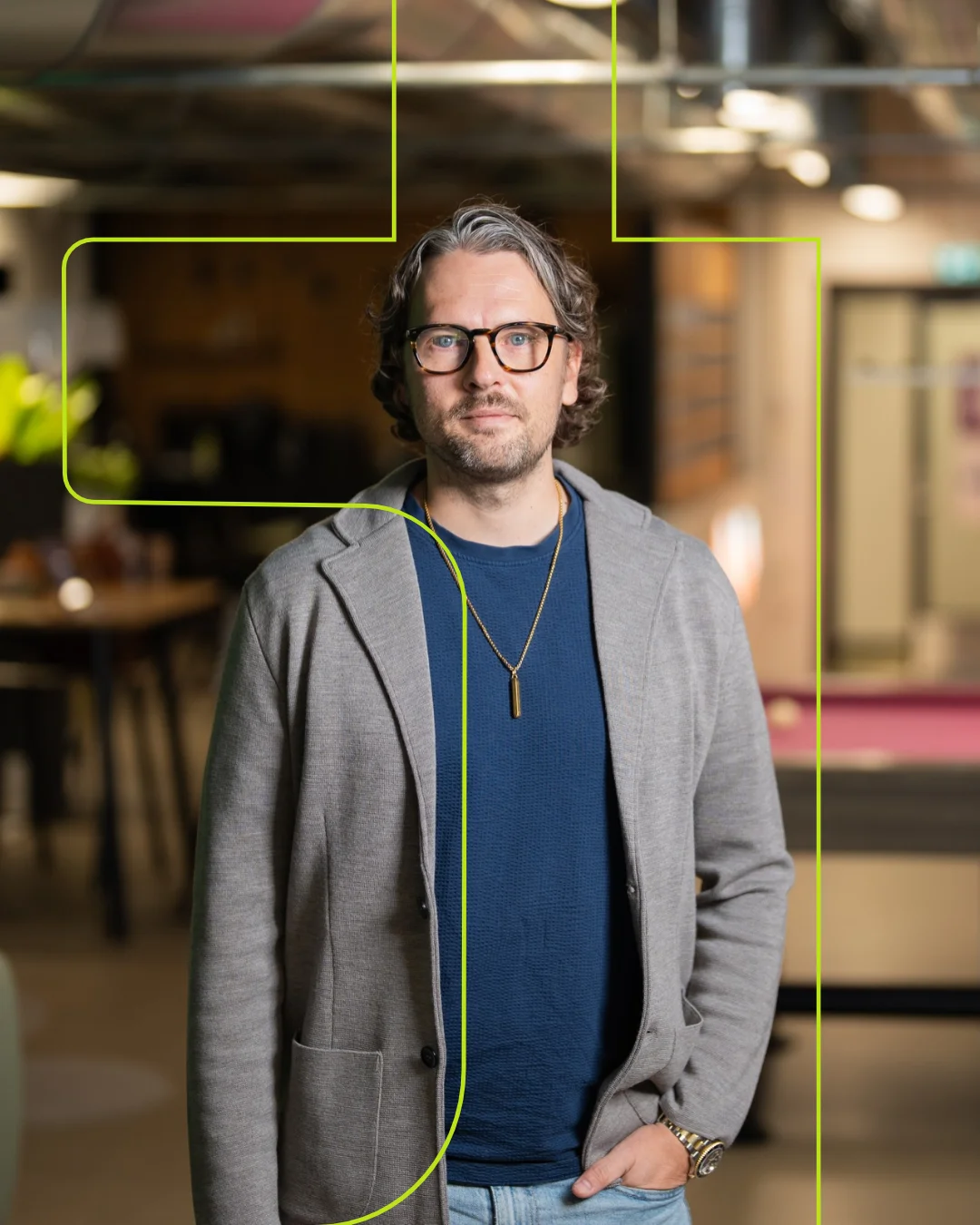
Qaicu founder Juhamatti Hyyppä, who develops internal artificial intelligence for companies, knows that building a growth company requires, in addition to a good idea, the courage to take even an unfinished product in front of customers. In Lahti, Qaicu has found in StartHub, which operates in connection with LAB University of Applied Sciences, not only a base for its company but also a community that has brought people, networks and an environment important for growth to entrepreneurship.
Qaicu’s origin story combines long experience in financial administration, an interest in business development and entrepreneurship, which has been part of Juhamatti Hyyppä’s life since childhood. As the son of an accounting firm entrepreneur and raised in an entrepreneurial family, he was already able to do bookkeeping at a young age. Soon, the numbers began to show something more than statutory financial administration.
“The numbers began to tell me a story about the company and its business. I noticed quite quickly that my actual passion was not bookkeeping, but management through financial figures,” Hyyppä says.
His career took him from financial administration to the software business, the management of a growth company and eventually to entrepreneurship of his own. Together with his brother and father, Hyyppä founded a company offering financial management services, alongside which the budgeting and reporting software Finazilla was later created. The company was sold to Lemonsoft in 2022.
After the acquisition, Hyyppä decided that he would no longer establish a company. And certainly, would not start developing software again. Things turned out differently.
The idea of internal artificial intelligence was born on an enduro trail
The idea of Qaicu began to take shape as Hyyppä experimented with language models and their possibilities in utilising business information. The actual insight was born quite far from the office: with an enduro bike in Vesivehmaa.
Hyyppä had tested how artificial intelligence interprets companies’ financial data, but the results were not convincing. In the middle of riding, it became clear to him why the analysis went wrong, and at the same time the idea of the data model on which Qaicu was later built was born.
Companies generate huge amounts of information in different places. Financial figures, production data, CRM systems, contracts, offers, work instructions and other documentation all tell part of the same business, but the information does not necessarily meet.
“I wanted to build an internal artificial intelligence for companies that can answer questions concerning the company’s business if the information has been taught to it,” Hyyppä summarises.
Qaicu brings together information from a company’s different systems so that it can be utilised with the help of artificial intelligence. The answers are based on the company’s own information, not on the general knowledge of artificial intelligence.
For Hyyppä, however, the significance of artificial intelligence is not in replacing people: “Artificial intelligence does not take away the importance of people. It makes a person a little more efficient and, at best, better. Meaningful use of artificial intelligence for me is that it is used to solve pain points between people.”
For example, a financial expert may know how to build an excellent report, but verbalising its significance to the rest of the organisation may be more difficult. On the other hand, a production expert may not be familiar with financial concepts. Hyyppä sees artificial intelligence as an interpreter between these worlds.
“The expert does not need to become unnecessary. Their role can change from an assembler of reports to an interpreter, developer and architect.”
Growth began with the team and the courage to sell
One of Qaicu’s first decisive stages was building the right team. Hyyppä wanted people around him who do not need to be alike, but who complement each other’s expertise and can trust one another.
The development team started in May 2025. Already in August of the same year, the first customer pilot began. “It required an efficient and good team to make the product and then the courage to sell. Sales, sales and then more sales,” Hyyppä emphasises.
The first customers were approached exceptionally openly. The product was only being built, and no one yet knew for certain whether the idea would work in practice.
“In the first sales calls, I said directly that we have this rather crazy idea and no clue whether it works. I asked whether they would join in and try it.”
The customers joined. Since then, the company has grown into a team of six people and gained more than one hundred active customer organisations. Hyyppä emphasises that growth has been built cashflow positively without external capital or debt.
During growth, one thing must not be forgotten, according to him: new customers must be sought continuously. “Even if there are dozens of implementations under way, the calendar must also contain new customer meetings. If there are none, soon there will be no deals either.”
StartHub brought a community around the entrepreneur
When Hyyppä began building Qaicu in Lahti, he was in a new kind of situation. Having moved from Jyväskylä, the entrepreneur did not have a ready-made professional network in the region. Growing the previous company had also taught him how lonely entrepreneurship can occasionally be.
The route to StartHub began by chance in a daycare yard, where Hyyppä met StartHub’s former team leader, Mark Poutanen. After the conversation came an invitation to get to know the activities.
When Qaicu’s first team member working in Lahti joined, the company moved into StartHub’s premises, which are free of charge for members. “I can say that my quality of life as an entrepreneur improved significantly from that day.”
For Hyyppä, it is not only about a workspace. When working at home, the boundary between the working day and free time disappeared easily. Going to StartHub brought rhythm to the day, but above all other people around him.
“Here you inevitably end up talking to people. When I leave for home, I have time to recover during the drive and I am more present for my family at home,” Hyyppä summarises his everyday life.
At the same time, StartHub has become a growth environment for Qaicu. It has been possible to respond to the company’s needs as it has grown, and people have become especially important to Hyyppä. “I feel that I have received support related to entrepreneurship in this region from StartHub’s staff. We have found amazing individuals through whom we have reached the wonderful place that StartHub is.”
In growth, technology is not the most important message
Qaicu’s next challenge is scaling. Along the way, the company’s original assumptions have also had to be challenged.
Hyyppä says that the company started from the idea that the possibilities of internal artificial intelligence for companies would in themselves arouse customers’ interest. In practice, however, adopting new technology requires a sense of security, concrete benefits and support for change.
“We cannot talk only about technology. We must be able to explain what everyday problems it solves. Technology should be faded into the background.”
Qaicu has identified growth opportunities especially in manufacturing industry, construction and expert business. Internationalisation has also already been explored, but Hyyppä wants to build growth in a controlled manner.
The goals are still high. The company is aiming for strong growth in the next financial period as well, but Hyyppä emphasises that growth should not be built solely on ambitious forecasts. Cash flow must withstand the development, and the service promise given to customers must be maintained during growth.
A good idea must be dared to be tested
Hyyppä’s own entrepreneurial path includes building companies, an acquisition, a decision to stop being an entrepreneur – and founding a new growth company. That is why his advice to someone considering their own business idea is practical;
“First, the idea must be written out. After that, it must be turned into numbers. A budget is a numerical business plan. At its best, it proves whether an idea that sounds good on paper is actually viable.”
When the idea withstands examination, the next step requires commitment, according to Hyyppä. And after that, customers are needed.
“Sales is interaction between two people. At the beginning, the customer may not yet have a need, because they do not know about you or your idea. The seller’s task is to be able to explain what this solves and how it helps. Good websites or a great brand alone does’t build a company. You must discuss with customers, listen and test whether the idea creates real value.”
The same idea can be seen in Qaicu’s growth and in the StartHub community: entrepreneurship requires the courage to act, but it does not need to be done alone.
Through StartHub, LAB University of Applied Sciences is involved in building an environment where entrepreneurs, companies, experts and the region’s networks can meet. In Qaicu’s story, the significance of precisely this kind of community becomes concrete: growth is built not only with a product, but also with the environment and people.
Link to Qaicu’s website: https://qaicu.ai/en/home/
Text: Tanja Metsätuuli, LAB Business Unit
Photo: Luca Eskelinen, LAB Studio